
The Hidden Cost of Labor vs. the Long-Term Val ue of Capital Equipment
For manufacturers facing labor shortages, rising wages, and increasing global competition, automation has become more than a productivity tool—it has become a strategic financial decision. While labor remains essential to every successful operation, many repetitive manufacturing tasks can now be performed more efficiently and economically through robotic automation.
When evaluating automation investments, business owners often compare the cost of a robot to the wage of an employee. However, that comparison overlooks several critical factors, including payroll taxes, benefits, turnover costs, productivity gains, and significant tax advantages associated with capital equipment purchases.
Let’s examine the numbers.
The True Cost of Labor
Suppose a manufacturer employs a machine operator earning $25 per hour.
At first glance, the annual cost appears to be:
- $25/hour × 2,080 hours = $52,000 per year
However, the actual employer cost is much higher once additional expenses are included:
Additional Labor Costs
- Social Security taxes
- Medicare taxes
- Unemployment insurance
- Workers’ compensation insurance
- Health insurance benefits
- Paid time off
- Training expenses
- Overtime premiums
- Recruiting and hiring costs
- Turnover-related productivity losses
For many manufacturers, the fully burdened cost of a $52,000 employee can easily exceed $70,000 to $85,000 annually.
And unlike capital equipment, labor costs generally increase every year through wage inflation, benefit increases, and labor market pressures.
The Capital Equipment Advantage
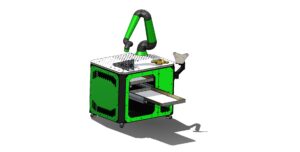
Now consider a robotic automation system with a purchase price of $250,000.
Many business owners initially view this as a large expense. In reality, it is an investment in a productive asset that can generate value for years.
A robotic system can often:
- Operate multiple shifts
- Produce consistent quality
- Reduce scrap and rework
- Improve throughput
- Minimize downtime caused by staffing shortages
- Eliminate overtime requirements
- Reduce workplace injuries
Most importantly, the robot does not incur payroll taxes, health insurance costs, vacation pay, or employee turnover expenses.
The Tax Benefits of Automation
One of the most overlooked advantages of automation is the favorable tax treatment of capital equipment.
Under current U.S. tax law, many manufacturers can take advantage of accelerated depreciation provisions that allow significant portions of equipment purchases to be deducted in the year the equipment is placed into service.
This can create a substantial reduction in taxable income and improve cash flow during the first year of ownership.
For example:
- Automation investment: $250,000
- Corporate tax rate: 21%
- Potential tax savings from accelerated depreciation: approximately $52,500
Actual tax treatment varies by business structure and current tax regulations, so companies should consult their tax advisor for specific guidance.
The key point is that a robot is not merely an expense—it is an asset that often provides meaningful tax advantages while generating productivity improvements.
Comparing Labor and Automation
Consider a production process requiring two full-time operators.
Labor Option
Annual cost per employee (fully burdened): $80,000
Two employees:
- Annual cost: $160,000
- Five-year cost: $800,000+
This does not include wage increases, turnover, overtime, or staffing shortages.
Automation Option
Robotic system:
- Initial investment: $250,000
- Annual maintenance and support: $10,000
- Five-year ownership cost: approximately $300,000
Even after accounting for maintenance and financing costs, the total ownership cost may be significantly lower than the equivalent labor expense.
In many cases, manufacturers achieve payback periods between 12 and 36 months.
Improved Productivity Creates Additional Returns
The labor savings alone often justify automation. However, the most successful automation projects generate value beyond labor reduction.
Robots can:
- Increase production capacity
- Improve product consistency
- Reduce defects
- Shorten lead times
- Enable lights-out manufacturing
- Improve customer satisfaction
These benefits often create additional revenue opportunities that further accelerate return on investment.
Automation Doesn’t Replace People—It Elevates Them
The most successful manufacturers are not using robots to eliminate their workforce. They are using automation to eliminate repetitive, physically demanding, and difficult-to-staff tasks.
Employees can then be reassigned to:
- Programming and operating equipment
- Quality control
- Process improvement
- Maintenance
- Customer support
- Higher-value manufacturing activities
In today’s labor market, many manufacturers are struggling to fill open positions. Automation helps companies continue growing despite labor shortages while creating more skilled and rewarding roles for their workforce.
Conclusion
When evaluating labor versus automation, the comparison should extend far beyond hourly wages.
Labor carries ongoing costs that include payroll taxes, benefits, turnover, and workforce management challenges. Capital equipment, on the other hand, provides long-term productive value, often qualifies for favorable tax treatment, and can significantly improve productivity and quality.
For many manufacturers, the question is no longer whether to automate. The question is how quickly they can deploy automation to improve profitability, strengthen competitiveness, and position their business for long-term growth.
The companies that view automation as a strategic investment rather than an expense are often the ones that gain the greatest competitive advantage in the years ahead.